Results
A total of 1,457 coded instances were identified across the Think Aloud recordings. Of these, 878 were produced by the amateur participants and 579 by the advanced participants. As the two groups produced different overall numbers of codes, each theme was also calculated as a percentage of the total codes produced by that experience group. The analysis identified differences in communication, team encouragement and confidence, outcome monitoring, and responses to performance errors (See Figure 1 & Table 1).
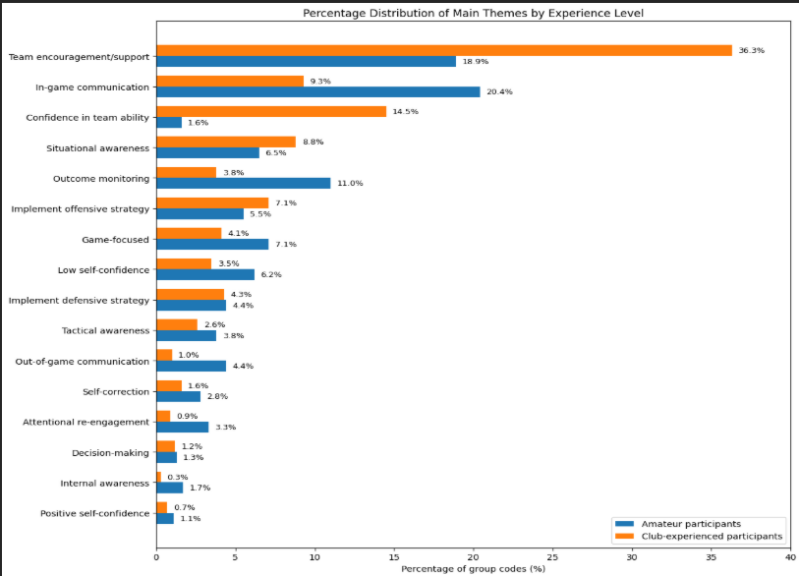
Figure 1: Percentage distribution of main themes among amateur and advanced basketball participants.
Table 1: Table of Themes
| Main Theme | Sub-Theme | Evidence | Amateur Players Total Codes | Advanced Players Total Codes |
|---|---|---|---|---|
| Game-focused | Ball trajectory focused | “I mean, we’re getting to the ring.” | 62 | 24 |
| Confidence in team ability | Team confidence; Boosting team morale; Confidence in teammate to dictate the start of play | “That was good though.” “Well done, guys.” “Hey! That’s the best we’ve done.” “That’s the play guys.” “Good rebound. That was good. Good, good.” | 14 | 84 |
| Low self-confidence | Negative self-evaluation; Negative emotional response; Negatively focused on the outcome; Negative internal reinforcement; Unsure in level of competency; Lacking confidence in shooting ability | “I’m just going to pass it off.” “Do not let me shoot.” “Oh, I’m not good. Oh my God!” “That's terrible. I shouldn’t shoot at all.” | 54 | 20 |
| Team encouragement/support | Positive in-game teammate encouragement; Positive sportsmanship;; Positive team encouragement | “Go for it! Go for it!” “Unlucky.” “Good try. That was the right idea.” “Bad luck.” “Good follow up.” “Good pressure guys.” | 166 | 210 |
| Tactical Awareness | Pre-offensive strategizing | “Keep putting pressure on.” “Yes, snatch it.” “...And I guess keep passes low instead of high?” “Yep, no – go in, go in.” “Come on guys! Pressure, pressure, pressure!” “Rebounds guys.” | 33 | 15 |
| Implement offensive strategy | “Maybe just call a name when passing.” “Maybe wait that second longer until someone is under the ring.” “If we wanna drag them out a bit.” | 48 | 41 | |
| Implement defensive strategy | “I think it worked well with 1 person guarding the ball then the other 2 guarding space.” | 39 | 25 | |
| In-game communication | Calling for possession; Offensive communication; Communicating position; Strategic communication; Communicating intent to pass | “Yeah, yeah.” “If you need.” “Back!” “Go in.” | 179 | 54 |
| Situational awareness | Noticing the time remaining; Players’ locations; Available space; The movement of the ball; Opponents; The outcomes of shots or passes; Forming strategy around opposition | “2 min, 2 min.” “In, in, ohh close shot.” “Man on, man on.” “Because he’s got the height to tackle them, but we don’t.” “Coming in.” “1:22 minutes left.” “48 seconds.” | 57 | 51 |
| Out-of-game communication | Out-of-game team communication; Out-of-game communication to opponent | “Thank you.” “Just hang on! Wait, wait, wait – we don’t have two defenders!” “I think it worked well with 1 person guarding the ball then the other 2 guarding space.” | 39 | 6 |
| Internal awareness | Physical preparation; Body awareness; Fatigue awareness; Physical arousal awareness; Performance readiness; Readiness to enter play; Pacing and slowing down | “Might need a bit of a stretch.” “So tired.” “Oh, my days, I’m so tired.” “Ooo, I’m exhausted.” “Yeah, I’ll start off.” “Let’s go, let’s go, 2 min.” “Take it slow.” “Good, I need a breather.” | 15 | 14 |
| Positive self confidence | Positive self-evaluation; Belief in personal ability; Confidence before performing; Positive expectations; Satisfaction after successful performance; Motivational self-talk | “Let me get this.” “Ooo, good shot.” “I got this.” “Yes, there we go.” | 10 | 4 |
| Self-Correction | Recognition of mistakes; Reflection after unsuccessful performance; Identification of missed opportunities; Corrective planning; Adjustment of pace or timing; Recognition of better alternative actions; Focused on technical reasoning behind failed pass; Tactical reminder | “I need to take my time.” “Should have passed it quicker.” “Should have got the rebound.” “Just gotta try and move into the open space.” “Keep watching the ball.” “Sorry Katrice that was my pass.” | 25 | 9 |
| Attentional Re-engagement | Refocusing after a mistake; Shifting attention to the next play; Returning to task-relevant cues; Re-engaging after a missed shot; Regaining defensive attention; Maintaining involvement after losing possession | “Oh shoot, rebound, rebound.” “More pressure, more pressure.” “Here if you need.” “Okay.” “Uh okay. Alright.” “Good work good pass.” | 29 | 5 |
| Decision-Making | Hesitation between possible actions; Uncertainty about what to do next; Considering passing, shooting or dribbling; Decision-making under time pressure; Choice of court position; Delegating responsibility to a teammate; Suggesting change in offensive strategy | “Might dribble down, who knows.” “Run down, shoot, dribble, shoot, pass, pass.” “You wanna have a go?” “Go back to the original plan maybe?” | 11 | 7 |
| Outcome Monitoring | Shot outcome awareness; Pass outcome awareness; Rebound outcome awareness; Defensive outcome awareness; Possession changes awareness; Focused on the technical outcome; Recognition of successful play; Recognition of unsuccessful play; Monitoring whether the ball was in or out; Monitoring whether a strategy worked; Focused on failed objective | “That’s not in.” “Good rebound.” “Yes, good block.” “Close shot.” “Oh! That’s too high. My bad, my bad.” “It just sat there.” “That was a sh*t pass.” “Ah! I'm so short.” | 97 | 22 |
In-Game Communication
In-game communication was the most common theme among amateur participants, with 179 coded instances, representing 20.4% of their total codes. In comparison, advanced participants produced 54 in-game communication codes, representing 9.3% of their total.
This theme included calling for possession, communicating court position, offering passing options and directing defensive actions. Examples included “Here if you need", “Here, middle", “Man on", and “Pressure, pressure". The results therefore showed that in-game communication formed a larger proportion of the amateur participants’ verbalisations (See Video 1).
Team Encouragement and Confidence
Team encouragement and support were the most frequent themes among advanced participants. Advanced participants produced 210 codes in this theme, which represented 36.3% of their total codes. Amateur participants produced 166 team encouragement and support codes, representing 18.9% of their total.
A similar difference was found for confidence in team ability. This theme represented 84 codes, or 14.5%, among advanced participants, compared with 14 codes, or 1.6%, among amateur participants. These themes included verbalisation such as “Good job", “Good try", “Let’s go", and “We’ve got this" (See Video 2).
Together, team encouragement and confidence accounted for 50.8% of the advanced participants’ codes, compared with 20.5% of the amateur participants’ codes.
Outcome Monitoring and Responses to Errors
Outcome monitoring was more common among amateur participants. Amateur participants produced 97 outcome-monitoring codes, representing 11.0% of their total, compared with 22 codes, or 3.8%, among advanced participants. Outcome monitoring included recognising whether a shot, pass, rebound or defensive action was successful. Examples included “That’s not in", “Good rebound", “Bad pass", and “Yes, good block".
Amateur participants also produced a greater proportion of low self-confidence, self-correction and attentional re-engagement codes. Low self-confidence represented 6.2% of amateur codes and 3.5% of advanced codes. Self-correction represented 2.8% of amateur codes and 1.6% of advanced codes, while attentional re-engagement represented 3.3% and 0.9%, respectively.
Examples of self-correction included “I need to take my time." “Should have passed it quicker" and “Should have got the rebound.” Attentional re-engagement was shown when participants redirected their attention towards the next action following an error, such as “Oh shoot, rebound, rebound” and “More pressure, more pressure.” (See Video 3)
Other comparisons
Situational awareness accounted for a slightly greater proportion of advanced participants’ codes, representing 8.8%, compared with 6.5% among amateurs. Advanced participants also produced a slightly greater proportion of offensive-strategy codes, at 7.1% compared with 5.5%.
The groups were similar in implementing defensive strategy and decision-making. Defensive-strategy codes accounted for 4.4% of the amateur group’s codes and 4.3% of the advanced group’s codes. Decision-making represented 1.3% and 1.2%, respectively.
Internal awareness was relatively uncommon but occurred more frequently among amateur participants, accounting for 1.7% of their codes compared with 0.3% among advanced participants. These instances included verbalisation concerning fatigue, physical readiness and bodily sensations, such as “I’m so tired” and “I’m exhausted".
Overall, amateur players made a larger share of in-game communication, outcome monitoring, self-doubt, self-correction and attentional re-engagement. Advanced players tend to produce a larger share of encouraging their team members, being confident in their team’s ability, and demonstrating situational awareness. The most significant differences between the two groups are in the category of team encouragement and support, followed by confidence in their team’s ability and then in-game communication. The results indicate that there are different patterns of behaviour for each of the four players; they should not be viewed as representative of behaviour for all amateur and experienced male basketball players.
Video 1: A shortened clip showing an amateur participant calling “Here, here, middle” while moving into an available position.
Video 2: A shortened clip showing an advanced participant encouraging teammates after an offensive approach.
Video 3: A shortened clip that shows an amateur participant missing a shot and immediately redirecting their attention to the rebound.
Create Your Own Website With Webador